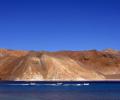
"As regards reports about a bridge being made by the Chinese side on Pangong Lake, the government has been monitoring this activity closely," External Affairs Ministry Spokesperson Arindam Bagchi said.

Chinese media on Wednesday criticised the western media for attempting to drive a "wedge" between India and China.

Raking up the border issue, Congress leader Rahul Gandhi on Friday said every individual in Ladakh knows that China has "taken away our land" and claimed that Prime Minister Narendra Modi's assertion that not an inch of land was taken away was "absolutely false".

'I want to assure this House that in these talks we have not conceded anything.' Full text of what Defence Minister Rajnath Singh told Parliament on the Chinese pullback in eastern Ladakh.

The names of 20 Indian Army personnel, who were killed while valiantly fighting Chinese troops in Galwan Valley in eastern Ladakh in June last year, were inscribed on the National War Memorial ahead of the Republic Day, official sources said.

Prime Minister Modi told President Xi that he has made efforts to improve ties with Islamabad but these efforts have been "derailed".
Only he, with his tremendous political capital and personal stature, can pull it off, observes B S Raghavan, the veteran civil servant.

It took India and the Indian Army to show to the world that enough is enough and to challenge the neighbourhood bully, he said.
Due to both sides undertaking patrolling up to their perception of the LAC, transgressions do occur.
China and India have agreed to work to maintain peace along the Line of Actual Control and resolve the border standoff through talks while implementing the consensus reached between the two countries' leadership that 'differences' do not escalate into 'disputes', a top Chinese official said.

Outgoing Indian envoy to China Vikram Misri on Monday had a virtual farewell call on Chinese Foreign Minister Wang Yi during which he said that "certain challenges" had overpowered the vast opportunities in the bilateral ties last year and hoped that with continued communication the two sides would be able to resolve the current difficulties.
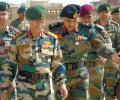
The main focus will be on the situation in eastern Ladakh where Indian and Chinese troops are locked in an eyeball-to-eyeball face-off in sensitive areas like Pangong Tso, Galwan Valley, Demchok and Daulat Beg Oldie
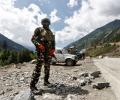
At a virtual media briefing, Ministry of External Affairs (MEA) Spokesperson Anurag Srivastava said disengagement of troops is a complex process which would require mutually agreed 'reciprocal actions'.
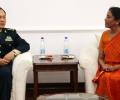
The two sides also decided on early operationalisation of the proposed hotline between the two armies as part of the confidence building measures, the defence ministry said.
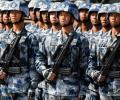
Chinese military has also deployed a sizeable number of its troops in Galwan Valley, the site of the violent clashes on June 15 that left 20 Indian soldiers dead.
The clear assertion by New Delhi came ahead of a fresh round of Lt General-level talks between the Indian army and the Chinese PLA which government sources said is set to take place within the next two days.


External Affairs Minister S Jaishankar on Wednesday took a critical view of some of the key decisions made by the Jawaharlal Nehru government, and said one needs to get out of this "cult worship" that the period from 1946 onwards was "great years" and the country did "splendidly".

China reiterated that no meaningful dialogue can be held with India until it "unconditionally" withdraws troops from the disputed Doklam area and said Foreign Minister Wang Yi has authoritatively made Beijing's position clear on the issue.
'Prime Minister Narendra Modi appears to have gone beyond the cautious approach usually advocated by the tightly-knit 'China group' in the ministry of external affairs in dealing with Beijing.'
The MEA spokesperson did not reply to questions like whether the US had approached India with the offer, whether New Delhi has communicated its response over it to Washington, DC or whether the Trump administration has been briefed about the current standoff between Chinese and Indian soldiers in eastern Ladakh.
The comments by External Affairs Ministry Spokesperson Anurag Srivastava came at a media briefing when asked about the fresh comments by the Chinese foreign ministry blaming India again for the border situation in eastern Ladakh.

The Chinese military has already completed moving back its troops from the face-off sites in Galwan Valley, Gogra and Hot Springs in line with the first phase of the disengagement process from the friction points on the LAC in eastern Ladakh, sources said. The main focus now shifts to Pangong Tso. India has been insisting that China must withdraw its forces from areas between Finger Four and Eight.
India and China are in talks to monitor the melting of glaciers in the Himalayas, a border region crucial to both countries' water supplies, Minister for Environment Jairam Ramesh has said. "We are talking to the Chinese about monitoring the Himalayan glaciers," Ramesh said. However, he cautioned that India would not allow Chinese scientists "to climb all over India's glaciers", but sought a collaborative research programme.

Assistant Secretary for East Asian and Pacific Affairs David Stilwell made the remark on Thursday, adding that the Trump administration is closely watching the Indo-China situation.

'They will try more rounds of military level talks and move it to the diplomatic and political domain to see if there is a possibility of a solution -- and like the CDS said if that does not happen, we are prepared.'

Over 68,000 Army soldiers, around 90 tanks and other weapon systems were airlifted by the Indian Air Force to eastern Ladakh from across the country for rapid deployment along the Line of Actual Control (LAC) after the deadly clashes in the Galwan Valley, top sources in defence and security establishment said.
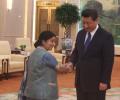
Chinese President Xi Jinping on Monday received External Affairs Minister Sushma Swaraj
China also hinted that India was objecting to its efforts to build the road in Donglang area of the Sikkim sector on behalf of Bhutan.

China said that it had put off the visit of Indian pilgrims who enter Tibet via the Nathu La pass "for safety reasons" in view of the border issue.

Northern Army commander Lieutenant General Upendra Dwivedi on Friday said the situation along the Line of Actual Control in eastern Ladakh was stable but in a state of "heightened alert" and asserted that there would be no security lapse on fronts of "operational preparedness and readiness" along the India-China border.
Instead of "the dragon and the elephant compete with each other", "the dragon and the elephant dance together, Chinese Foreign Minister Wang Yi said.
India's top military and strategic brass on Tuesday reviewed the overall situation in eastern Ladakh amid indications that the latest round of talks between senior military commanders of Indian and Chinese armies on the next phase of disengagement of troops may not have produced encouraging results, people familiar with the developments said.
Singh said a meeting between senior Indian and Chinese military leaders has been scheduled for June 6 even as he asserted that India is not going to back off from its position. Asked about the current situation in sensitive areas in eastern Ladakh, he said Chinese have come up to what they claim is their territory while Indians believed it is theirs.
'Prime Minister Narendra Modi appears to have gone beyond the cautious approach usually advocated by the tightly-knit 'China group' in the ministry of external affairs in dealing with Beijing.'

The Chinese military on Friday confirmed that the troops of China and India have begun the process of disengagement from the Patrolling Point 15 in the Gogra-Hotsprings area of eastern Ladakh in a 'coordinated and planned way'.
India and China are understood to have discussed the latest row over Sikkim on Thursday, during talks between their Foreign Ministers, dominated by the festering boundary issue, with the two sides agreeing to use existing mechanisms whenever necessary to maintain peace and tranquility along the border.External Affairs Minister Pranab Mukherjee, who is on a four-day official visit to China, met his counterpart Yang Jiechi and discussed issues of mutual concern.

On the Ukraine conflict, Modi said, "Some people say that we are neutral. But we are not neutral. We are on the side of peace." "All countries should respect international law and the sovereignty of countries," he said.

'We can expect heightened belligerence from China.'

Dai Bingguo, who served as the China's boundary negotiator with India from 2003 to 2013, told Chinese media, "If the Indian side takes care of China's concerns in the eastern sector of their border, the Chinese side will respond accordingly and address India's concerns elsewhere."
